

How to Use an AI Assistant in Your Private Practice Without Losing the Human Touch
Running a successful private practice requires far more than providing exceptional clinical care. Between returning phone calls, responding to emails, documenting sessions, managing schedules, updating your website, and following up with prospective clients, administrative responsibilities can quickly consume the hours you'd rather spend supporting clients or simply taking care of yourself.
It's no surprise that many therapists are exploring artificial intelligence (AI) to lighten their workload. AI-powered tools have become increasingly accessible and can automate repetitive administrative tasks, improve organization, and save valuable time.
But one question continues to surface: Can you embrace AI without sacrificing the personal connection that makes therapy so meaningful? The answer is yes.
When implemented thoughtfully, AI can enhance your operations while allowing you to remain fully present where it matters most: with your clients.
AI Should Support Your Practice, Not Replace Your Relationships
Therapy is built on trust, empathy, and authentic human connection.
While AI has become remarkably capable, it cannot replace clinical judgment, emotional intelligence, or the therapeutic alliance that develops between a therapist and client.
Instead, think of AI as an administrative assistant, not a therapist.
Its greatest value lies in handling repetitive, time-consuming tasks that don't require your expertise, allowing you to focus on the work only you can do.
Administrative Tasks AI Can Help Automate
Many daily operational responsibilities follow predictable patterns, making them ideal candidates for AI assistance.
Examples include:
Drafting emails
Creating appointment reminders
Organizing notes
Summarizing meeting transcripts
Creating checklists
Brainstorming blog topics
Writing first drafts of newsletters
Generating social media captions
Developing Standard Operating Procedures (SOPs)
Creating task lists
Brainstorming marketing ideas
These activities often consume hours each week, even though they don't directly generate revenue or improve clinical outcomes.
By delegating these responsibilities to AI, private practice owners can create more space for client care and strategic growth.
Where Human Support Still Matters

Although AI can significantly improve efficiency, some responsibilities require compassion, discretion, and sound judgment.
For example:
Answering calls from someone experiencing emotional distress
Responding to sensitive client emails
Scheduling urgent appointments
Navigating insurance questions
Handling intake conversations
Managing client relationships
Coordinating communication between providers
These interactions require emotional awareness and adaptability that technology simply cannot replicate.
That's why many successful practices combine AI tools with experienced human support.
At The Mental Health VA, our bilingual, HIPAA-certified Mental Health Facilitators help bridge the gap between technology and compassionate client service by providing live answering services, inbox management, administrative support, and operational assistance designed specifically for mental health practices.
The Best AI Workflow Is a Hybrid Workflow
Rather than asking whether AI should replace people, a better question is: Which tasks should AI handle, and which tasks require a human?
A balanced workflow might look like this:
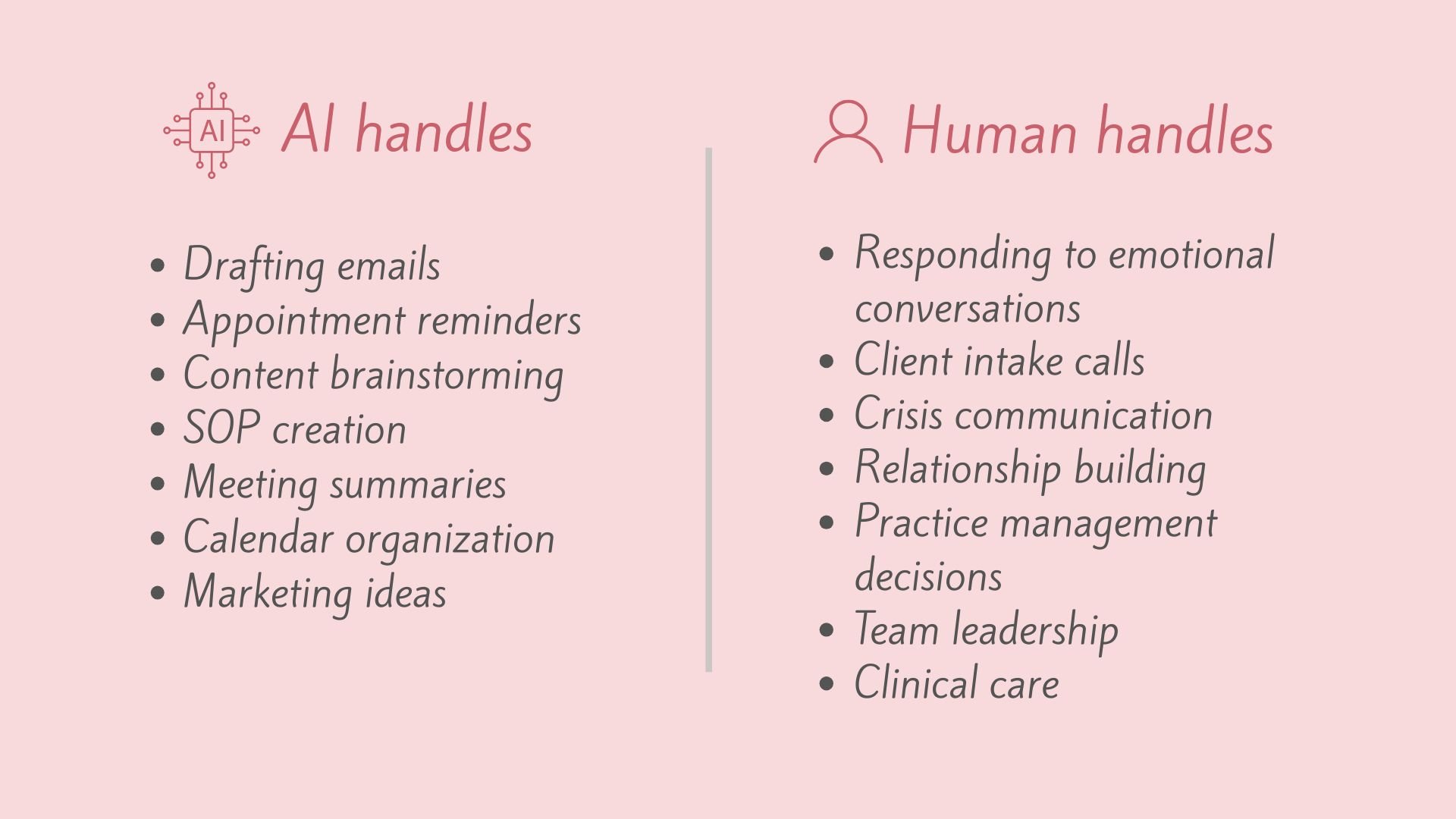
The perfect way to include AI in a private practice is a hybrid workflow.
This hybrid approach allows therapists to maximize efficiency without compromising the client experience.
Be Mindful of HIPAA and Client Privacy
Before using any AI platform in your practice, it's important to understand how client information is processed and stored.
Avoid entering:
Protected Health Information (PHI)
Client names
Dates of birth
Diagnoses
Treatment details
Insurance information
Whenever possible:
Use HIPAA-compliant software.
Review each platform's privacy policies.
Limit AI to administrative workflows unless the platform specifically supports healthcare compliance.
Develop internal policies for staff using AI tools.
Protecting client confidentiality should always remain the top priority.
Ways Therapists Are Already Using AI Successfully
Private practice owners are finding creative ways to integrate AI into their businesses without replacing human interaction.
Common examples include:
Marketing Support
AI can generate blog outlines, newsletter drafts, podcast summaries, and social media content that therapists can personalize before publishing.
Operations
Practice owners use AI to build SOPs, organize workflows, write training documents, and document recurring processes.
Administrative Assistance
AI can help draft professional emails, create meeting agendas, organize project plans, and summarize internal discussions.
Content Creation
Whether updating a website or answering frequently asked questions, AI can provide strong first drafts that save hours of writing time.
Common Mistakes to Avoid
AI is powerful, but only when used intentionally.
Avoid these common pitfalls:
Relying on AI for Clinical Decisions
AI should never replace professional judgment or evidence-based treatment planning.
Publishing AI Content Without Reviewing It
Always edit AI-generated content to ensure accuracy, professionalism, and alignment with your voice.
Removing Human Contact
Automating every interaction can make your practice feel impersonal. Clients often remember how they were treated long before they remember how quickly they received an automated email.
Ignoring Privacy
Never assume every AI platform is appropriate for handling sensitive information.
AI Won't Replace Great Operations

One misconception about AI is that it eliminates the need for administrative support.
In reality, AI works best when integrated into well-designed systems.
Someone still needs to:
Oversee workflows.
Manage client communications.
Maintain consistency.
Update processes.
Monitor quality.
Ensure nothing falls through the cracks.
Technology becomes significantly more valuable when paired with experienced operational support.
That's where a specialized virtual assistant team can make a meaningful difference.
The Mental Health VA Difference
At The Mental Health VA, we believe technology should strengthen -not replace- the relationships at the heart of mental healthcare.
Our bilingual, HIPAA-certified team understands the unique needs of therapists and private practice owners. We provide personalized administrative support, live answering services, inbox management, online presence management, and operational assistance so you can focus on delivering exceptional care.
Rather than asking you to choose between AI and human support, we help you build a workflow that combines the strengths of both.
The result?
More efficient operations.
Better client communication.
Fewer administrative headaches.
More time for therapy.
A practice that scales without losing its personal touch.
Final Thoughts
Artificial intelligence is transforming how private practices operate, but successful practices understand that efficiency should never come at the expense of empathy.
The most effective approach isn't choosing between AI and people.
It's allowing AI to automate repetitive administrative work while experienced professionals continue delivering the warmth, responsiveness, and personal connection clients expect.
When technology and human expertise work together, everyone benefits, including your clients.
If you're ready to build a more efficient practice without sacrificing compassionate care, schedule a consultation with The Mental Health VA. We'll help you create systems that support your growth while preserving the human touch that sets your practice apart.
Frequently Asked Questions
-
Yes. AI can help automate administrative and operational tasks like drafting emails, organizing workflows, brainstorming content, and creating SOPs. It should complement--not replace- clinical expertise and client relationships.
-
Some AI platforms offer HIPAA-compliant solutions, while many consumer AI tools do not. Always verify compliance and avoid entering protected health information into tools that aren't designed for healthcare.
-
No. AI excels at repetitive administrative work, but experienced virtual assistants provide empathy, judgment, personalized communication, and operational oversight that AI cannot replicate.
-
Many therapists benefit from automating appointment reminders, administrative writing, content creation, workflow documentation, task management, and marketing support while keeping client-facing interactions personal.
-
Start with low-risk administrative tasks such as drafting emails, creating checklists, organizing documents, or brainstorming content. As you become comfortable, integrate AI into broader operational workflows while maintaining human oversight.